AI is no longer just a technology: it has become a geopolitical supply chain
This report by Singaporean expert Damien Kopp analyses 25 national strategies and reaches a clear conclusion: the pursuit of autonomy is increasingly being built on borrowed technologies. We have entered the age of the “sovereignty paradox.” The more governments and companies invest in building their own AI capabilities, the more they reinforce their structural dependence on a small number of foreign suppliers for chips (GPUs), cloud infrastructure and foundation models.
AI is no longer simply a technology; it has become a “geopolitical supply chain”, comparable to energy, structured around a limited number of critical bottlenecks. Each layer is highly concentrated, territorially anchored, governed by specific legal frameworks and therefore potentially subject to geopolitical leverage. The strategic question is no longer one of ownership, but of controlling critical dependencies and ensuring the ability to continue operating in the event of disruption.
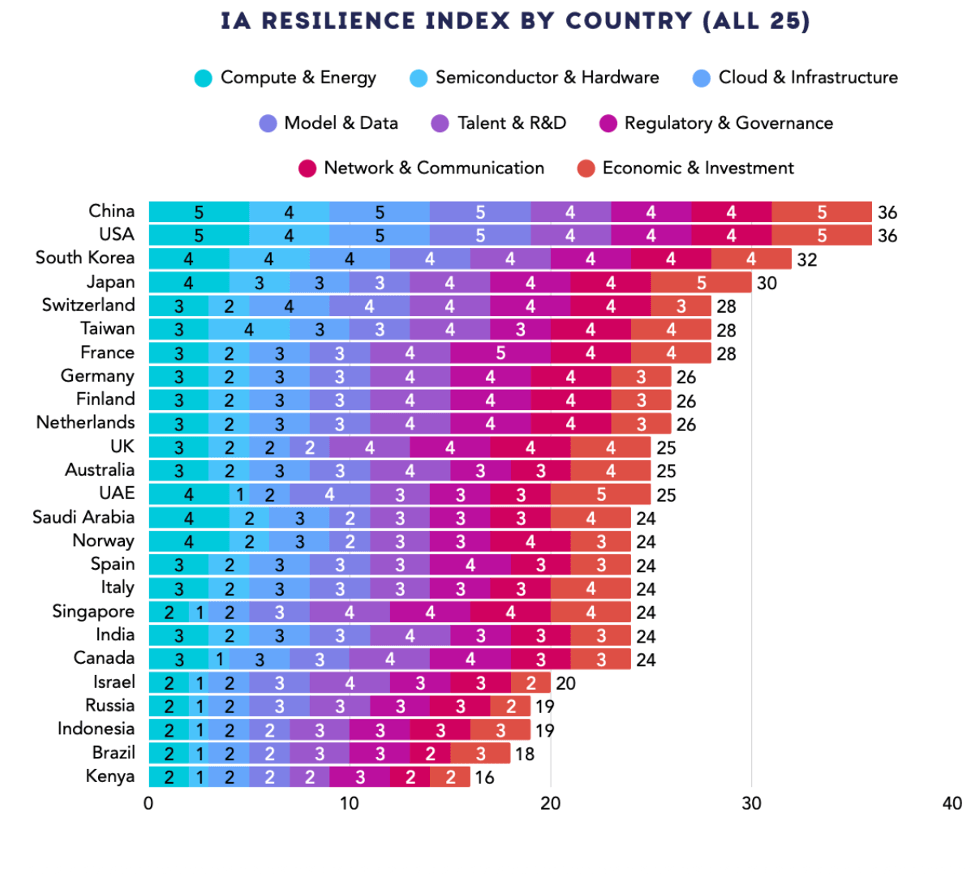
The comparative analysis of 25 countries shows that only the United States and China come close to achieving “full-stack” sovereignty across hardware, cloud, models and data. For the rest of the world, the reality is one of dependency management, structured around four main archetypes.
For business leaders, this means that the question is no longer “Where do we buy from?” but rather: “How do we move from managing AI to governing it as a geopolitically exposed supply chain?”
Key recommendations
For both businesses and public policymakers:
-
Treat AI as a strategic business continuity risk, on a par with energy and other critical supply chains.
-
Make dependencies visible and measurable through dedicated tools, such as the Digital Resilience Index, in order to prioritise investment where disruption would have the greatest impact.
-
Build resilience by design through technology-agnostic architectures, supplier diversification, exit capabilities, and local control over data and models.
-
Elevate AI governance to board and executive level, fully integrating geopolitical, energy and industrial considerations.
Lessons for Europe
The report highlights a conclusion that is both counter-intuitive and decisive: Europe can genuinely regain control over its digital destiny.
While Europe’s capabilities remain fragmented today, pooling them at European level would create the critical mass required to compete with the United States and China.
The Japanese and South Korean trajectories demonstrate that a path towards strategic autonomy is possible, including across the so-called “hard layers” such as semiconductors and compute infrastructure.
This requires an integrated European strategy that turns the Digital Single Market into a common framework for investment and deployment, while pursuing an open approach towards global partners that share our values and face similar geopolitical vulnerabilities.
The study shows that Europe’s gap is not structural, but organisational:
-
if Europe genuinely combined its strengths, its score would rise from 28 to 34;
-
and if it pooled investment in the “hard layers”, following the Japanese model, Europe could reach parity with the United States and China, with a score of 36 out of 40.